What are the tests for a home office deduction?
Publication 587 says you must use part of your home in one of these ways:
- Exclusively and regularly as your principal place of business
- Exclusively and regularly as a place where you meet or deal with clients or customers in the normal course of your business
- In the case of a separate structure that is not attached to your home, in connection with your business
- On a regular basis for certain storage use, or as a daycare facility, which have their own rules
What does exclusive use mean?
You use a specific area of your home only for your trade or business. The area can be a room or another separately identifiable space, and it does not need a permanent partition. You fail the test if you use the area for both business and personal purposes.
What does regular use mean?
You use a specific area on a regular basis. Incidental or occasional business use is not regular use, and the IRS considers all the facts and circumstances.
When is my home my principal place of business?
The IRS looks at the relative importance of the activities done at each place you work and the time spent at each. Your home office qualifies if you use it exclusively and regularly for administrative or management activities, such as billing, keeping books, ordering supplies, setting appointments or writing reports, and you have no other fixed location where you do substantial administrative or management work.
Some things do not disqualify it. Having another company do your billing, doing minimal paperwork in a car or hotel room, or choosing your home office over office space you could use elsewhere all leave your home eligible.
The IRS examples include a self-employed plumber who works mostly at customers' sites but runs the business from a home office, and a sales representative who visits customers and writes orders at home. Both qualified.
What if I meet clients at home, or use a separate building?
If you physically meet clients on your premises and their use of your home is substantial and integral to your business, the space you use exclusively and regularly for it qualifies, even if it is not your principal place of business. Occasional meetings and telephone calls do not count.
A separate free-standing structure, such as a studio, workshop, garage or barn, qualifies if you use it exclusively and regularly for your business, even if it is not your principal place of business.
Who cannot claim it?
An employee. The Publication 587 flowchart ends with no deduction when you use the part of your home as an employee. If you also use the home for an activity that is not a trade or business, such as managing your own investments, that use does not qualify.
What limits the amount?
If the gross income from the business use of your home is less than your total business expenses, the deduction for certain expenses is limited. You also cannot deduct home costs for any part of the year you did not use your home for business.
Sources: IRS Publication 587 (2025), Business Use of Your Home (read October 31, 2026); IRS Publication 334 (2025), Tax Guide for Small Business (read October 30, 2026); IRS Publication 17 (2025), Your Federal Income Tax, miscellaneous deductions (read October 31, 2026).
File the proof as you go
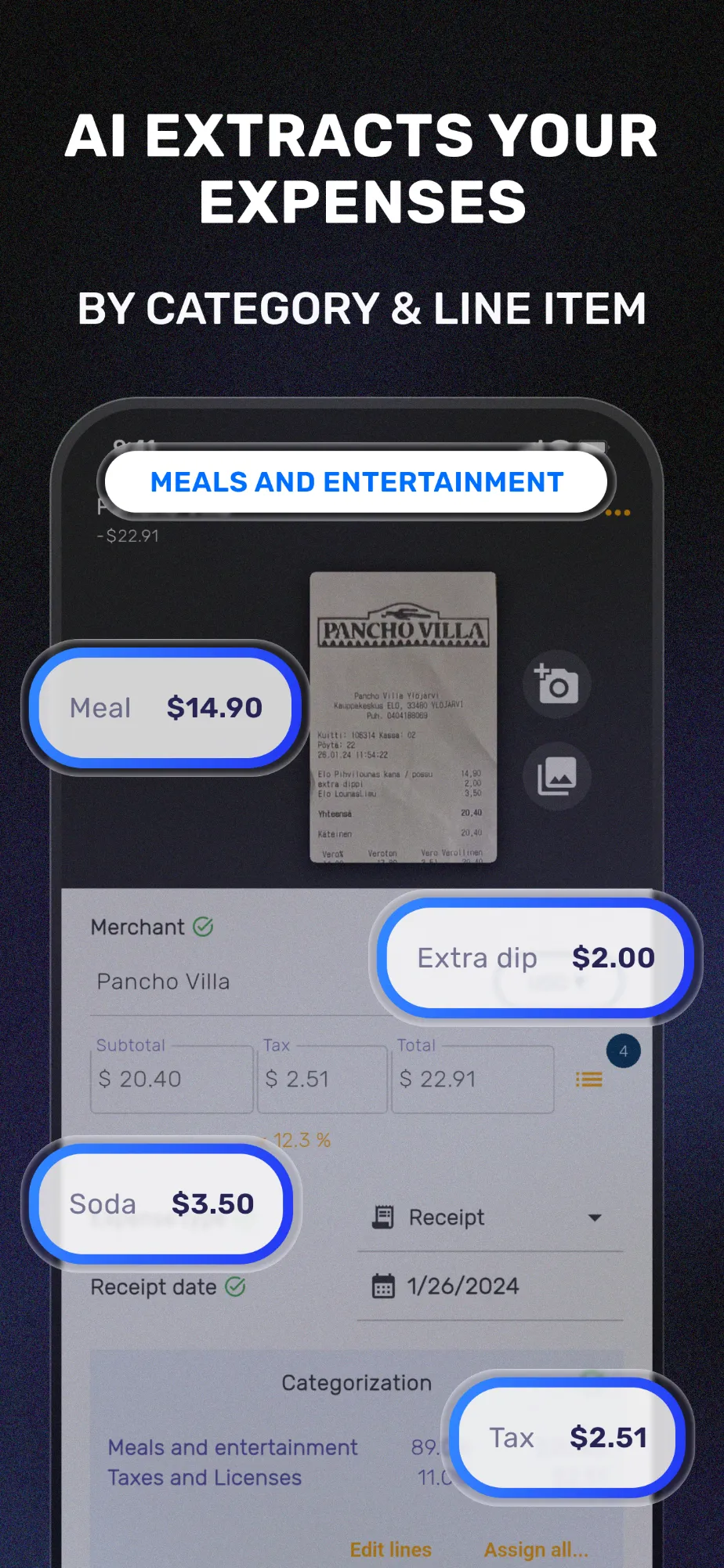
SparkReceipt reads each receipt line by line on the Elite plan, so supplies and office costs are filed by category in seconds. 7-day free trial.
We earn a commission if you subscribe via our links. We're not SparkReceipt.