Can renters claim the home office deduction?
Yes. Publication 587 says a home includes a house, an apartment, a condominium, a mobile home or a boat. It also says that if you rent the home you occupy and meet the requirements for business use of the home, you can deduct part of the rent you pay. To figure the deduction, you multiply your rent payments by the percentage of your home used for business.
The requirements are the same as for an owner: you use the part of your home for your own trade or business, regularly and exclusively, and it is your principal place of business, a place where you meet clients, or a separate structure. An employee cannot claim it.
How do I work out the business percentage?
The IRS says you can use any reasonable method, and gives two common ones. Divide the area used for business by the total area of your home. Or, if the rooms are all about the same size, divide the number of rooms used for business by the total number of rooms.
The IRS examples: an office of 240 square feet in a home of 1,200 square feet is 20%, and one room out of ten rooms of about equal size is 10%.
What does a rent example look like?
This is our own example, with made-up numbers, to show the arithmetic. An apartment is 900 square feet. A bedroom of 90 square feet is used only as an office. The business percentage is 90 divided by 900, which is 10%. If the rent is $3,000 a month, that is $36,000 a year, and 10% of it is $3,600.
The amount you can deduct is then limited by the gross income from the business use of your home, as the next section explains.
Does a bedroom or part of the living room count?
The exclusive use test asks for a specific area of your home used only for your trade or business. The IRS says the area can be a room or other separately identifiable space, and it does not need to be marked off by a permanent partition. A spare bedroom used only as an office is the kind of space the test describes.
You fail the test if you use the area for both business and personal purposes. In the IRS example, a den used to write legal briefs that the family also uses for recreation does not qualify. So a desk in a living room corner counts only if that area is used for nothing but business.
What else can a renter deduct?
Publication 587 lists other costs you may deduct in the same business percentage when you use your home for business:
- Utilities and services such as electricity, gas, trash removal and cleaning, at the same percentage as the area
- Insurance that covers the business part of your home
- Repairs that relate to your business, such as painting the office or fixing a leak
- The business part of a security system you maintain and monitor
What about my phone line?
Publication 587 says the basic local service charge for the first landline into your home is a personal expense. Charges for business long distance calls on that line, and a second line used only for business, are deductible business expenses, and you do not include them in the home office amount. The IRS pages we used do not list internet service separately, so ask a tax professional how to treat it.
Can renters use the simplified method?
The simplified method applies to the business use of a home, and the IRS counts an apartment as a home. You multiply $5 by the area you use for business, up to 300 square feet. For the 90 square feet in our example that is $450. Our guide Simplified Home Office Deduction explains what you give up by choosing it.
What limits the deduction?
If your gross income from the business use of your home is less than your total business expenses, the deduction for expenses like utilities and insurance is limited to that income, after the business costs not related to your home. You also cannot deduct costs for any part of the year you did not use your home for business: if you began on July 1, count only the last half of the year.
Sources: IRS Publication 587 (2025), Business Use of Your Home (read October 31, 2026); IRS Publication 334 (2025), Tax Guide for Small Business (read October 30, 2026); IRS, What kind of records should I keep (read October 30, 2026).
Snap the receipt for every office cost
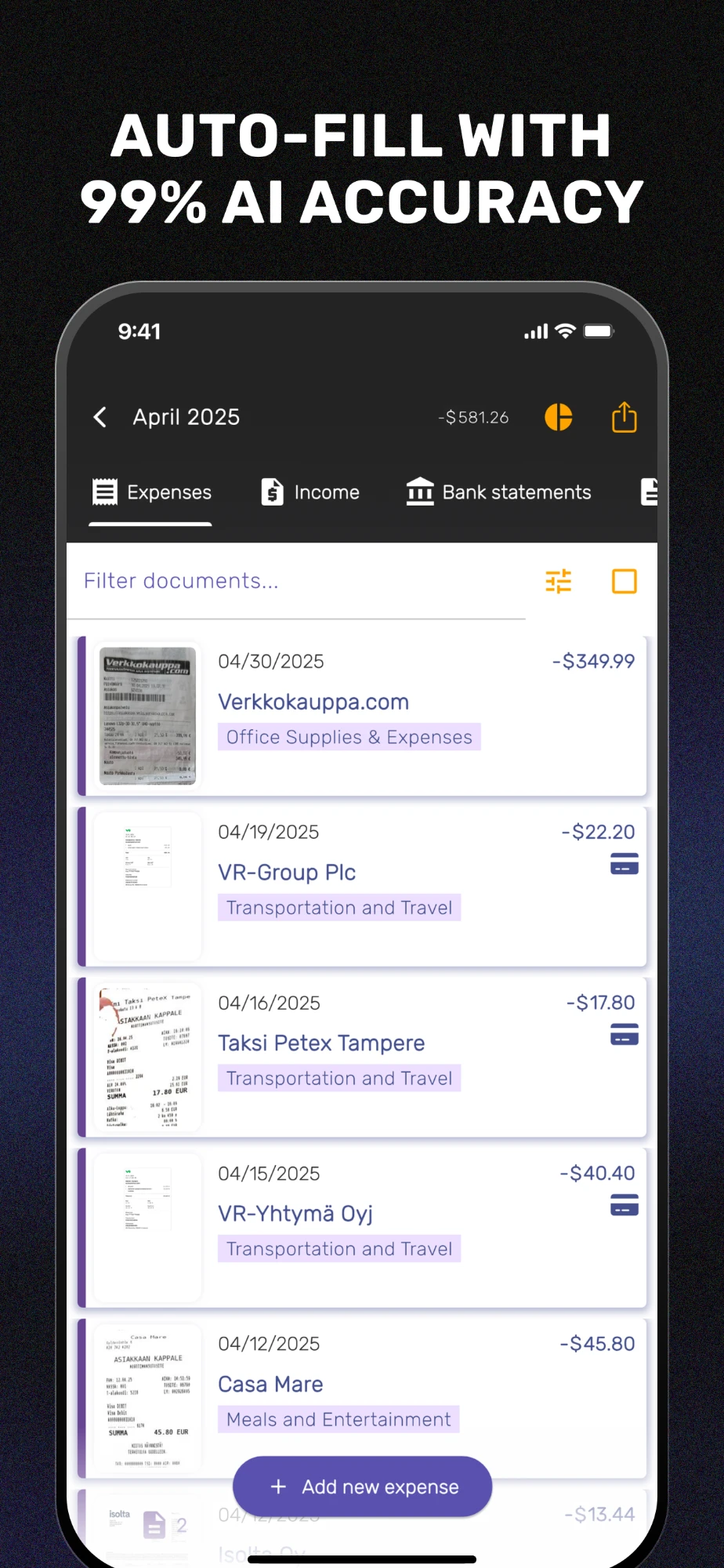
SparkReceipt reads receipts from your phone and inbox and files them by category, so utilities, supplies and repairs are ready at tax time. 7-day free trial.
We earn a commission if you subscribe via our links. We're not SparkReceipt.